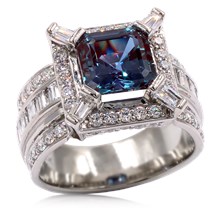
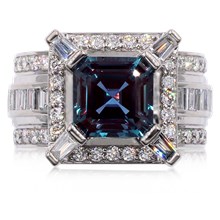
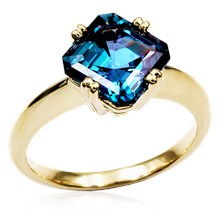
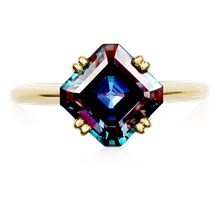
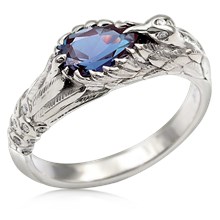
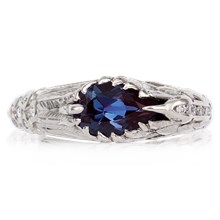
Alexandrite for Engagement Rings
.jpg)
Natural and Lab-Grown Alexandrites
Few gemstones captivate quite like alexandrite, a rare and remarkable stone celebrated for its dramatic color change and exceptional durability. Revered by collectors and connoisseurs alike, alexandrite shifts hues with light, creating a gemstone that feels alive, expressive, and deeply personal. Beyond its mesmerizing beauty, alexandrite offers impressive strength and stability, making it a compelling choice for fine jewelry and engagement rings alike. Whether you are drawn to its scientific intrigue, rich history, or symbolic connection to transformation and individuality, alexandrite stands apart as one of the most extraordinary gemstones found in nature.
Alexandrite Hardness: Exceptional Strength and Stability
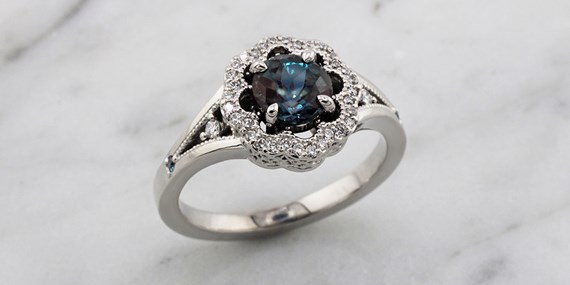
Alexandrite is actually a variety of chrysoberyl. It has a hardness of 8.5 and excellent toughness. It has no cleavage (the tendency to fracture when struck), and it is resistant to chemicals, heat, and light, making it a very stable gemstone.
It is usually not treated or enhanced, although it can have inclusions and sometimes fracture-filling. Be sure to purchase your special gem from an AGTA member, who is voluntarily bound by contract to disclose all treatments on gemstones (such as Krikawa).
Alexandrite History
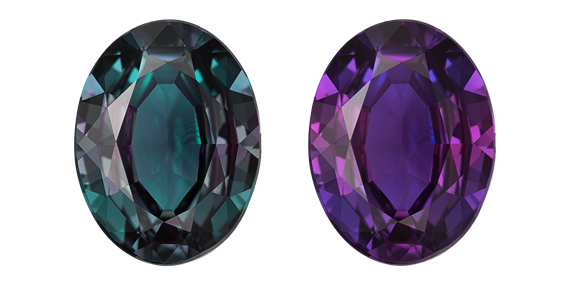
This extraordinary gemstone was first discovered in 1830 in Russia’s Ural Mountains, a region long known for its rich mineral deposits. Alexandrite’s remarkable color change, shifting from lush green in daylight to rich red under incandescent light, mirrored the official colors of the Russian Empire, quickly capturing national pride and fascination.
In honor of this symbolism, the gem was named after the future Czar Alexander II to commemorate his coming of age. Almost immediately, alexandrite became associated with prestige, power, and good fortune, and was coveted by the Russian nobility and later admired by gem collectors around the world. Its rare optical phenomenon and imperial origins have secured alexandrite a lasting place among the most storied and sought-after gemstones in history.
Natural Alexandrite Rarity
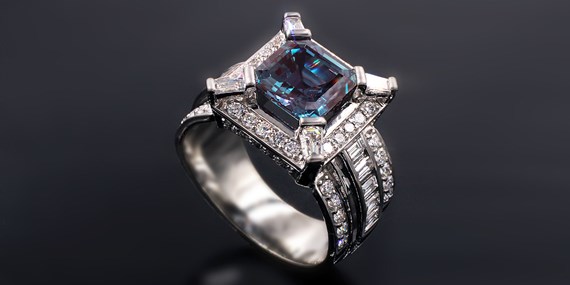
The original source of alexandrite was in the Ural Mountains of Russia, and that mine is now long closed, as it contained only a small pocket of fine gems. Other small pockets have been found in Zimbabwe, Sri Lanka, and Brazil. Unfortunately, gems from these mines exhibit poor to only moderate color change. A more recent find in Brazil has yielded a fair-sized batch of fine color-change gemstones, making this gorgeous stone available to interested collectors again.
Even with the opening of this mine in Brazil, fine gem-quality alexandrite remains extremely rare and expensive. Many fine alexandrites can be found in period jewelry; however, new loose fine gemstones are also available.
Lab-Grown Alexandrite for Engagement Rings
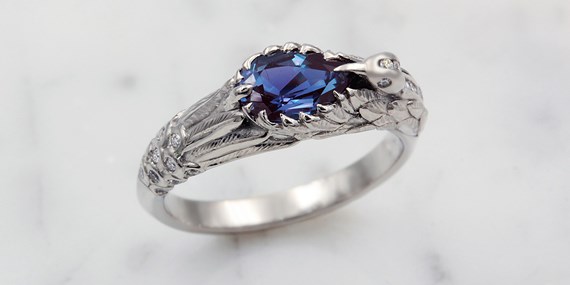
Lab-grown alexandrite offers all the magic of one of the world’s most fascinating gemstones, without the limitations of rarity. Known for its remarkable color-changing ability, alexandrite shifts hues with the light, creating a gemstone that feels alive and deeply personal.
At Krikawa, we offer lab-created alexandrite as a beautiful, ethical, and highly durable option for custom jewelry, delivering the same optical brilliance and molecular structure as natural alexandrite while offering greater design, size, and budget flexibility.
Natural and Lab-Grown Alexandrite FAQ's
Q: What is Synthetic vs. Imitation Alexandrite?
A: A Chatham-created alexandrite is not an imitation, but merely an alexandrite grown in a human-controlled environment. In other words, it has the same properties as an earth-mined alexandrite.
It is important to note the difference between lab-created and imitation. Both are SIMULANTS, or "made to look like" the original gemstone; however, a lab-created (synthetic) gem has all of the same properties as the original, such as crystal shape, molecular composition, and hardness.
An imitation can be made of glass or even plastic; it is only made to look like it and does not have to share any other properties.
Q: Why should I purchase a lab-grown alexandrite?
A: Lab-grown alexandrites are a high-quality synthetic stone with the same atomic and optical properties as an alexandrite mined from the earth. Unless you're a certified gemologist with a powerful microscope, you won't be able to tell the difference between lab-created and mined gemstones.
Lab-grown alexandrites may even look better than their mined counterparts! Synthetic gems are grown under laboratory conditions; computers control the temperatures, while foreign materials found in the earth are removed from the starting chemicals.
Q: Is an alexandrite affordable?
A: A lab-grown alexandrite is much less expensive than natural alexandrite, resulting in a significantly more affordable gemstone. Lab-grown alexandrite is an excellent choice for those seeking an affordable precious gemstone without compromising the quality or sacrificing the aesthetic of their jewelry.
Q: Is a lab-grown alexandrite environmentally friendly?
A: Because crystal formation occurs in a lab rather than on Mother Earth, there is less environmental impact. Go green by choosing a lab-grown alexandrite.