Opalescent & Iridescent Gemstones for Engagement Rings
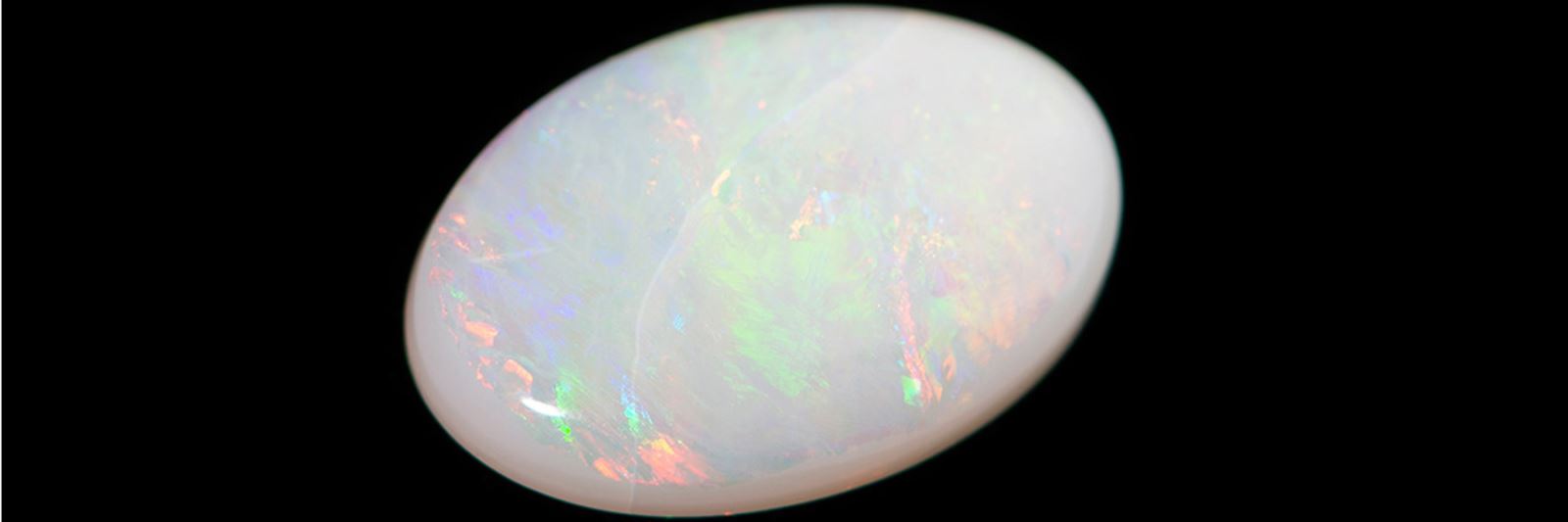
A Guide to Glow, Light, Character and Wearability
Some gemstones sparkle. Others seem to glow.
Opalescent and iridescent gemstones offer a softer, more atmospheric kind of beauty than a traditionally transparent stone. Their appeal often comes from the very characteristics conventional grading systems once tried to minimize: silk, clouds, microscopic inclusions, internal layers and unusual interactions with light.
A sapphire may have a velvety haze that makes its color seem illuminated from within. Another gemstone may reveal flashes of rainbow color when it moves. Moonstone can carry a floating veil of light across its surface, while a star sapphire may display a luminous star created by microscopic inclusions hidden inside the crystal.
These effects make the gemstone feel alive. They shift with movement, change under different lighting and reveal details that may never be obvious in a still photograph.
For an engagement ring, that individuality can be especially compelling. Instead of choosing a gemstone because it perfectly represents an established ideal of clarity and brilliance, you may fall in love with one precisely because of its clouds, glow, silk or unexpected flash of color.
What Makes a Gemstone Opalescent or Iridescent?
The terms opalescent and iridescent are sometimes used interchangeably in jewelry descriptions, but they refer to different visual effects.
Opalescence describes a soft, milky or hazy appearance caused when extremely small internal particles scatter light through a gemstone. Instead of light passing cleanly through the stone, it diffuses in multiple directions, producing a luminous or misty appearance.
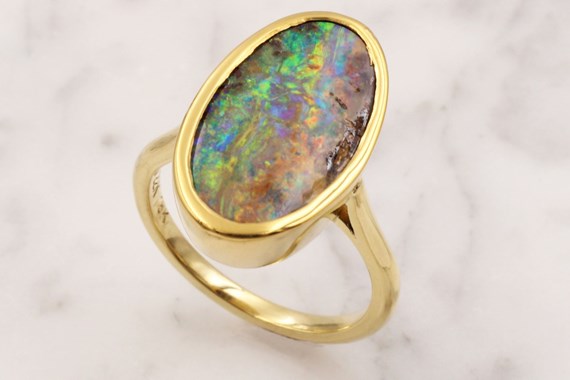
This is why an opalescent gemstone may be described as silky, sleepy, cloudy, velvety or glowing. These words are not necessarily describing different gemstone varieties. They are often describing the way light behaves inside the stone.
Iridescence is different. It creates shifting rainbow-like colors that appear as the gemstone or viewing angle changes. These colors can be produced when light interacts with extremely thin layers, fractures, inclusions or microscopic structures within or on the surface of the material. Different wavelengths interfere with one another, creating flashes of blue, green, pink, violet, gold and other spectral colors.
A sapphire, for example, may contain an internal natural feature that produces a tiny rainbow flash when the stone is tilted. That is iridescence rather than opalescence, although the same gemstone could potentially have a soft hazy appearance as well.
There are several related effects that belong to this same fascinating world of gemstone optics. Silk is the gem-trade name for extremely fine needle-like inclusions, commonly rutile in sapphire and ruby. When these inclusions are abundant, they can scatter light and create a soft, velvety appearance. When they are strongly organized within the crystal, the same type of inclusions can produce chatoyancy, the narrow band of light associated with cat's-eye gemstones, or asterism, the star seen in star sapphires and rubies.
Moonstone produces another effect called adularescence, a floating glow that seems to move beneath the surface of the gem. Precious opal displays play-of-color, the moving flashes of spectral color for which opal is famous. Fluorescence is different again: it is a visible glow produced when certain gemstones react to ultraviolet light.
Each phenomenon has a different gemological cause, but they all demonstrate just how much more a gemstone can do with light than simply sparkle.
Why We Love These Gemstones for Engagement Rings
Opalescent and iridescent gems have personality.
Their beauty is rarely completely uniform. A gemstone may contain a glowing area beside a clearer one, a veil of silk running through the center, a subtle haze around the edges or one remarkable internal flash that appears only when the ring moves.
That irregularity is often exactly what makes the stone memorable.
For someone looking for an unconventional engagement ring, these gems offer an alternative to the highly standardized appearance of a traditional brilliant diamond or uniformly colored sapphire. Instead of asking whether the stone is perfectly clear, the more useful question becomes whether its internal character is beautiful.
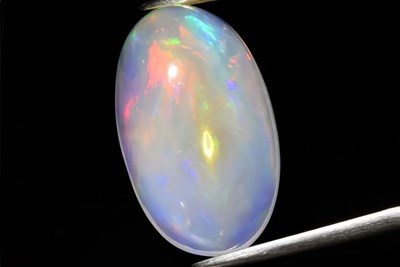
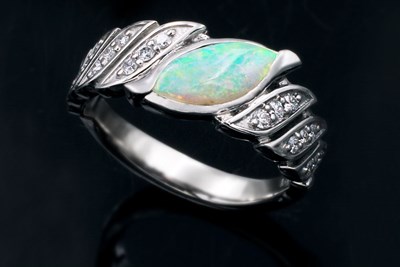
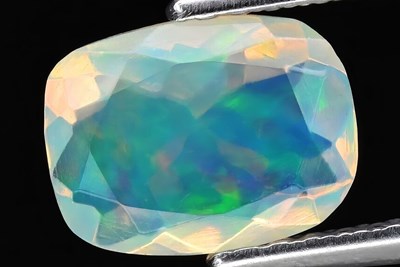
Some opalescent gemstones look almost watercolor-like. Others resemble ice, mist, clouds or moonlight. Some retain enough transparency to sparkle around their internal haze, while others are nearly opaque and derive their beauty almost entirely from color and glow.
The best examples tend to have life. Their milkiness should enhance the gemstone rather than simply make it look dull or chalky. Their inclusions should create visual interest without introducing structural problems. Most importantly, the stone should continue to appeal under the lighting conditions in which it will actually be worn.
That is why we like to evaluate unusual gemstones from several angles and under different types of light. A gemstone that looks extraordinary under concentrated jewelry lighting may appear very different next to a window, outdoors in shade or under normal household lighting. With an opalescent or iridescent stone, seeing those variations is part of understanding its personality before committing to it.
Which Opalescent Gemstones Work Best for Engagement Rings?
For daily wear, opalescent sapphire is one of the strongest choices available. Sapphire ranks 9 on the Mohs scale and generally has excellent toughness, making a structurally sound stone very well suited to an engagement ring.
Opalescent sapphires can have an extraordinary range of appearances. Some are softly translucent with an almost diffused glow, while others contain dramatic silk, wispy clouds or localized flashes of iridescence. The effect can appear in blue, teal, green, pink, lavender, gray, white and many intermediate colors.
Silky sapphires are also particularly interesting because many beautiful examples are unheated. Heat treatment can alter or dissolve microscopic rutile silk, so in some stones the very inclusions that once might have been considered undesirable are now part of what collectors and designers are seeking. Unheated, however, does not automatically mean better. Every sapphire should still be judged according to its beauty, condition and suitability for wear.
Spinel can also develop a soft, luminous or opalescent appearance. With a Mohs hardness of 8 and good toughness, spinel is another strong candidate for engagement rings. Fine opalescent examples are relatively uncommon, particularly when the gem combines attractive translucency, strong visual character and a sound internal structure.
Chrysoberyl is another durable possibility. It ranks approximately 8.5 on the Mohs scale and has excellent toughness. While opalescent chrysoberyl is not especially common, the species is famous for another inclusion-driven optical effect: cat's-eye chrysoberyl, where oriented microscopic structures create a sharp moving line of light across the gem.
Milky diamonds offer a different interpretation of the look. They may appear white, gray, brown or softly colored, with everything from a slight hazy veil to a nearly opaque storm-cloud appearance. Some retain visible sparkle within the haze, while others have a much softer, more diffuse character.
Diamond is the hardest natural gemstone, but hardness refers primarily to resistance to scratching. A highly included diamond can still contain fractures or vulnerable areas that affect durability, particularly near the girdle, corners or points. Milky diamonds therefore need to be evaluated individually rather than assuming every diamond will have identical wear characteristics.
Read more about milky diamonds and Storm Cloud Diamonds.
Milky aquamarine can be beautifully icy and ethereal, with a softer appearance than the transparent pale-blue aquamarine typically seen in traditional jewelry. Aquamarine ranks approximately 7.5 to 8 on the Mohs scale, making it wearable in a ring with reasonable care. A protective setting becomes more important if the stone contains significant fractures or vulnerable internal features.
Then there is opal, the gemstone most people immediately associate with opalescence. Precious opal is famous for play-of-color, where spectral flashes move across the stone, while common opal may instead display a softer translucent or glowing appearance.
Opal is considerably more delicate than sapphire, spinel or diamond. With a Mohs hardness generally around 5 to 6.5, it is more vulnerable to scratching, chipping and impact. An opal can absolutely be used in an engagement ring, but the wearer should understand that it requires more mindful care and may eventually need to be replaced. When we design with opal for frequent wear, calibrated shapes and protective, lower-profile settings can make future maintenance easier.
Moonstone offers yet another kind of glow. Its characteristic floating light, known as adularescence, can give the stone an almost supernatural quality. Moonstone, however, ranks only around 6 to 6.5 on the Mohs scale and has relatively poor toughness, making it a better choice for someone comfortable with mindful wear rather than a highly active lifestyle.
Choosing the Right Stone Is About More Than Hardness
One of the most common misconceptions about engagement-ring gemstones is that the Mohs scale tells you everything you need to know about durability.
It does not.
Hardness measures resistance to scratching and abrasion. Toughness measures resistance to chipping and breaking, while stability describes how a gemstone responds to heat, chemicals, light and environmental changes.
Those distinctions are particularly important with opalescent gemstones because visible inclusions are part of their appeal.
A sapphire filled with microscopic silk may be perfectly sound and durable. Another gemstone that looks much clearer could contain a single surface-reaching fracture that creates a greater risk during setting or daily wear.
This is why we evaluate more than how cloudy or included a stone appears. We look for open fractures, cavities, weak points, surface-reaching inclusions and internal features that might complicate setting, repair or long-term wear.
The same principle applies to cutting. Some opalescent stones are faceted so they can retain sparkle while showing their internal haze. Others are cut as cabochons because a smooth domed surface better emphasizes adularescence, chatoyancy, asterism or play-of-color.
Neither approach is inherently better. The best cut is the one that reveals what is exceptional about the individual gemstone.
Designing Around the Gemstone's Glow
These stones become especially interesting in a custom engagement ring because the setting can be designed around the exact way the gem interacts with light.
A lower profile may offer more protection for a delicate stone. A bezel or partial bezel can shield vulnerable edges. Pointed shapes may benefit from additional protection around their tips. Open areas beneath a more translucent gemstone can allow light to move differently through the stone, while the metal color surrounding it can influence how warm or cool the gemstone appears.
Even small details matter. If an iridescent sapphire has one incredible internal rainbow flash visible from a particular direction, we do not want a prong positioned directly over it. If a silky stone has a more attractive orientation, the setting can be designed to present that side naturally when the ring is worn.
With an unusual gemstone, the center stone should not simply be dropped into a preexisting design. Its individual personality can help determine the architecture of the ring.
Are Opalescent Gemstones Lower Quality?
Not necessarily. They simply challenge some of the conventions traditionally used to judge gemstones.
Classic gemstone grading often rewards high transparency, even appearance and minimal visible inclusions. Under those standards, silk, clouds and haze may be treated as clarity characteristics to be minimized.
But when those same characteristics create an extraordinary glow, velvety appearance or unusual optical effect, they can become the very reason someone chooses the gemstone.
That does not mean every cloudy stone is rare, valuable or desirable. A gemstone should still have an attractive overall appearance, thoughtful cutting, good polish and an internal condition appropriate for its intended use. A stone that looks flat or chalky simply because it is heavily included is very different from one whose inclusions create a luminous visual effect.
Exceptional examples can also be surprisingly scarce. As designers and collectors have become more interested in silky sapphires, milky diamonds, opalescent spinels and other unconventional material, particularly beautiful specimens have developed their own following.
The idea of perfection changes.
Instead of asking whether the gemstone contains inclusions, we begin asking what those inclusions do.
Do they make the gemstone glow? Do they create movement? Do they reveal an unexpected flash of color? Do they make you want to turn the stone over, tilt it toward the light and look again?
For the right person, that is far more interesting than perfect clarity.
Is an Opalescent or Iridescent Engagement Ring Right for You?
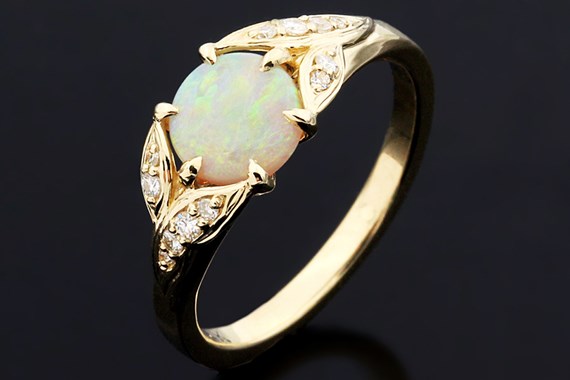
An opalescent or iridescent gemstone may be right for you if you are more interested in individuality than uniformity.
Perhaps you love a sapphire that looks as though a cloud is suspended inside it. Maybe a tiny rainbow flash appears only when you turn your hand. Perhaps a moonstone's floating glow or an opal's shifting color feels more personal than conventional brilliance ever could.
For regular daily wear, sapphire, spinel, chrysoberyl and carefully evaluated diamond are among the strongest options. Aquamarine can also be a beautiful choice with thoughtful protection, while opal and moonstone require more mindful wear.
The goal is not to find the clearest gemstone.
It is to find the one you keep looking at.
Sometimes the characteristic that makes a gemstone technically imperfect is exactly what makes it unforgettable. And when a ring is designed specifically around that individual stone, its glow, inclusions, flashes and tiny surprises become part of something that cannot be precisely duplicated.
